For all your Water Purification Needs | Zim | South Africa

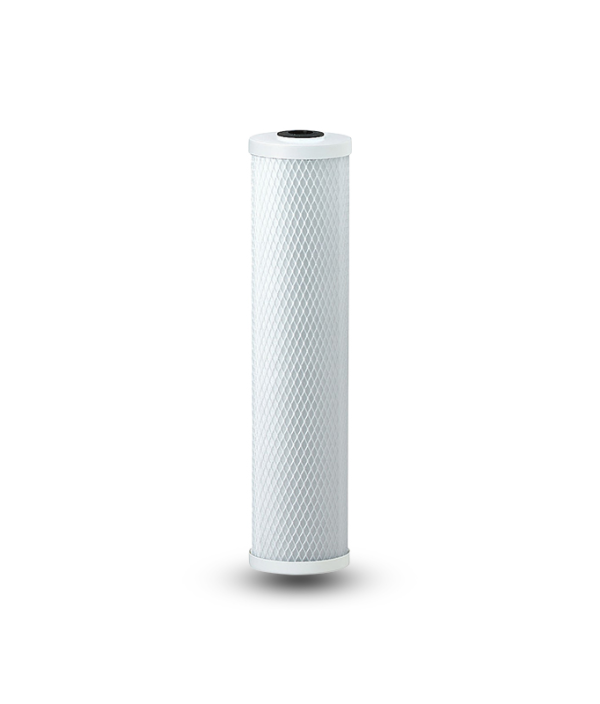
Plants Pro | 20″ BB CTO Filter
R195.00
CTO Carbon block filters are made from activated carbon and its specific function is the chemical adsorption of impurities and contaminants in drinking water.
The activated carbon block filter is highly effective for removing contaminants from water, thanks to its extensive surface area that facilitates the adsorption of dissolved substances. The solid carbon block further improves performance by preventing channeling, increasing surface contact time, and allowing for tailored pore sizes for enhanced mechanical filtration. Carbon blocks are among the most effective and commonly used technologies in Point of Use (POU) drinking water treatment.
This comprehensive guide addresses key considerations a buyer should evaluate when designing a carbon block filter and selecting a supplier, including:
Activated Carbon for Water Filtration
Why Carbon Block is the Better Choice
How Carbon Blocks Filter Water
Compressed vs. Extruded Carbon Block Manufacturing Processes
Carbon Block vs. Other Filtration Technologies
Design Parameters
Performance Indication Device
Advantages of a Custom Filter
Choosing a Custom Carbon Block Supplier
Your Custom Carbon Block Specifications
Function Of An Activated Carbon Block Filter Cartridge:
Carbon block filters are made from activated carbon. Its function is to adsorb chemical impurities and contaminants in drinking water. Carbon filters are widely used to remove chlorine, taste, odor, and color.
Features An Activated Carbon Block Filter:
5um filtration
Highly effective filtration of water for certain VOC’S, Chlorine, taste, and odor.
Low-pressure Drop. High-pressure performance.
Extra dust holding capacity.
Greater solids holding capacity.
Longer service life.
Various media are available.
No leaching carbon ash.
Benefits
Active removal of man-made and natural contaminants such as Chlorine, Benzene, Simazine, Lindane, and many more.
What Is The Difference Between Charcoal And Activated Charcoal?
Activated charcoal has been treated with oxygen to open up millions of small pores between the carbon atoms. Special manufacturing techniques have been used and this results in highly porous charcoals that have surface areas of approximately 300-1900 square meters per gram. These active charcoals are used to adsorb odorous or colored substances from a wide variety of liquids and gases alike. The importance here is absorption.
When a material adsorbs something, it attaches to it by a specific chemical attraction. The immense surface area of activated charcoal gives it countless bonding opportunities. When certain chemicals pass close to the surface of the carbon, they get attached to it and are not allowed to pass any further.
Activated charcoal is good at capturing certain carbon-based impurities and is also actively used to capture chemicals like chlorine.
CTO Carbon block filters are made from activated carbon and their specific function is the chemical adsorption of impurities and contaminants in drinking water. Carbon filters are widely used to remove chlorine, taste, odor, and color.
By removing these unwanted byproducts, you can rest assured that you will have access to fresh and clean water. Providing your home with pure, healthy, and clean water by using a filter. This Activated Carbon Block eliminates all contamination from your water, these filters provide you with a durable solution to your filtration needs.
Function:
CTO filter cartridge is widely used in industrial water treatment, household machines, and so on. It requires a CTO filter cartridge as the third stage of pretreatment. It is a link that cannot be removed during the pretreatment process. If the RO system is not equipped with a CTO filter cartridge, water directly enters. RO membrane, there are too many microorganisms that have been treated, bacterial viruses will block in the RO membrane, and the water has taste and color, the life of the RO membrane will be shortened, and the final quality of the water will also be affected.
5um filtration
Highly effective filtration of water for certain VOC’S, Chlorine, taste, and odor.
Low-pressure Drop. High-pressure performance.
Extra dust holding capacity.
Greater solids holding capacity.
Longer service life.
Various media are available.
No leaching carbon ash.
Benefits
Active removal of man-made and natural contaminants such as Chlorine, Benzene, Simazine, Lindane, and many more.
What is activated carbon (charcoal) and why is it specifically used in filters?
What is the difference between Charcoal and Activated Charcoal?
Activated charcoal has been treated with oxygen to open up millions of small pores between the carbon atoms. Special manufacturing techniques have been used and this results in highly porous charcoals that have surface areas of approximately 300-1900 square meters per gram. These active charcoals are used to adsorb odorous or colored substances from a wide variety of liquids and gases alike. The importance here is absorption.
When a material adsorbs something, it attaches to it by a specific chemical attraction. The immense surface area of activated charcoal gives it countless bonding opportunities. When certain chemicals pass close to the surface of the carbon, they get attached to it and are not allowed to pass any further.
Activated charcoal is good at capturing certain carbon-based impurities and is also actively used to capture chemicals like chlorine.
Only logged in customers who have purchased this product may leave a review.
Reviews
There are no reviews yet.